
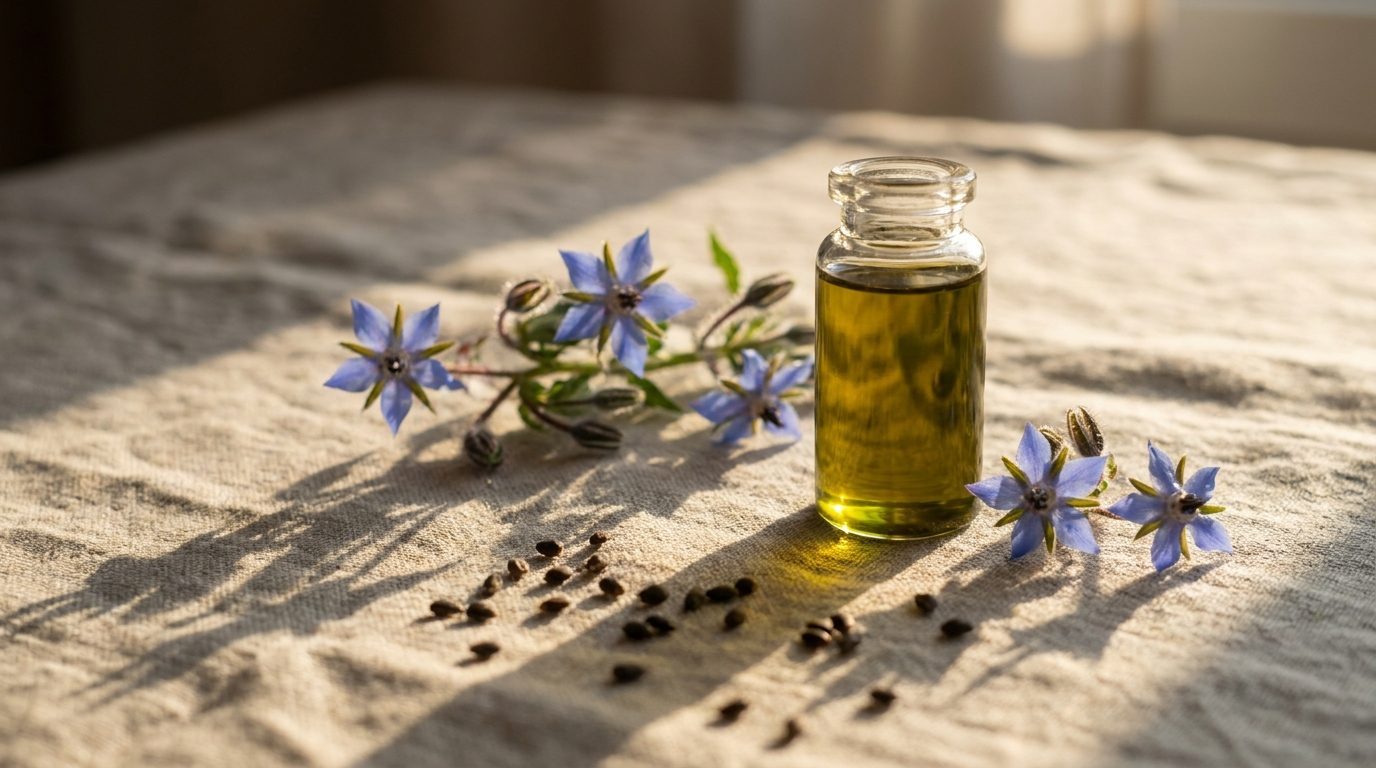
Almost every discussion of hemp seed oil eventually mentions GLA, usually without explaining it. It is one of the few genuinely unusual things about the oil, and it is worth understanding before you decide how much it should matter to you.
What GLA actually is
Gamma-linolenic acid is an omega-6 fatty acid with eighteen carbons and three double bonds. Despite the similar name, it is not the same as alpha-linolenic acid, the omega-3 in flax and chia — the two sit in different families and do different things.
GLA occupies a specific position in fat metabolism. Your body takes linoleic acid, the everyday omega-6 that dominates most vegetable oils, and converts it into GLA using an enzyme called delta-6-desaturase. GLA is then elongated into dihomo-gamma-linolenic acid (DGLA), which serves as the raw material for a family of signalling compounds. In other words, GLA is not a dead end — it is a junction on a pathway your body runs constantly.
Why almost no foods contain it
Most plants stop at linoleic acid and never make the next step, which is why the fats in canola, sunflower, corn, soy, olive and peanut oil contain effectively no GLA. A handful of plant families do carry the enzyme needed to produce it, and their seeds are the only meaningful dietary sources: evening primrose, borage, blackcurrant, a few less common species — and hemp.
That scarcity is the entire reason GLA appears in supplement aisles as capsules rather than as an ingredient. Hemp seed oil is unusual in delivering it as part of a food you can pour on dinner.
How much GLA is in hemp seed oil?
GLA typically makes up a small single-digit percentage of hemp seed oil's total fat, and the exact figure varies considerably with cultivar, growing region, season and how the seed was handled. Because a tablespoon of any oil is about fourteen grams of fat in total, a few percent works out to a fraction of a gram — real, but modest.
This is where honest framing matters. Dedicated GLA supplements made from evening primrose or borage oil are far more concentrated, which is exactly what they were formulated for. Hemp seed oil is not a GLA supplement in disguise; it is a food oil that happens to contribute some GLA alongside its linoleic acid, ALA, oleic acid and vitamin E. If you specifically want a concentrated GLA intake, hemp oil is an inefficient way to get there.
Why a dietary source might matter at all
If your body already makes GLA from linoleic acid, why care about eating it? Because the conversion step is a rate-limited one. The same delta-6-desaturase enzyme handles omega-3 conversion as well, so the two families compete for it, and its activity varies from person to person and tends to be lower in some circumstances. A dietary source bypasses that first step.
What that translates into physiologically at food-level amounts is not something a bottle label can promise. The mechanism is well described; the size of the effect from a spoonful of oil is a different question, and one where the evidence is thinner than the marketing.
Does GLA survive storage and cooking?
GLA is polyunsaturated, with three double bonds, which makes it as vulnerable as the rest of hemp oil's fragile fats. Heat, light, oxygen and time all degrade it. Practically, that means:
- Buy oil in dark glass or a tin, not clear plastic.
- Refrigerate after opening and close the cap properly each time.
- Buy a bottle size you will finish in weeks, not a bulk jug.
- Use it cold — dressings, dips, drizzles — rather than in a hot pan.
- Choose unrefined cold-pressed oil, since refining strips out the fragile minor components along with the colour and scent.
An oxidized bottle still lists the same fatty acid profile on the label, because labels report typical composition rather than what is in your particular bottle after three months on a sunny counter.
How to think about GLA when you shop
Treat GLA as a reason hemp seed oil is nutritionally interesting rather than as a reason to take it medicinally. It is a genuine point of difference from flax, canola or olive oil, it comes packaged with the rest of hemp's balanced fat profile, and it costs you nothing extra to obtain if you are already using the oil. What it is not is a substitute for a targeted supplement, and no one can tell you in advance what a fraction of a gram a day will do for you personally.
If GLA is the reason you are considering hemp seed oil, buy a small bottle of unrefined cold-pressed oil, keep it cold, and use a tablespoon a day in food you would eat regardless — over grains, stirred through hummus, whisked into a vinaigrette. That gets you the GLA in the form nature packaged it, along with everything else in the oil, without pretending a food is a therapy. If you are after concentrated GLA for a specific reason, that is a conversation to have with a clinician or dietitian, not a decision to make from a shelf. Our other hemp seed oil guides cover storage and label reading in more detail.